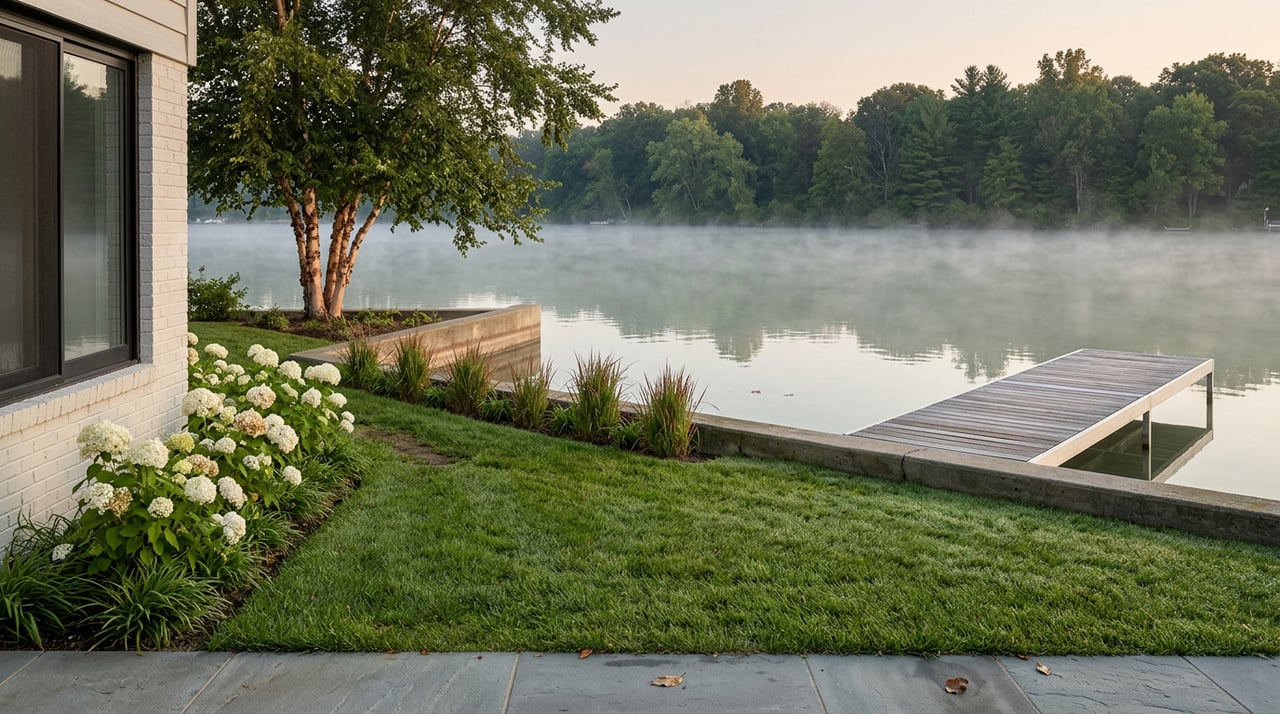
Walk the shoreline of a Lake Orion waterfront listing in August and the seawall looks fine. The concrete cap is dry, the water sits a few inches below it, and nothing about the scene tells you what's happening below the waterline. That's the problem. On most lakes, a marine inspector can time a visit around the buyer's schedule. On Lake Orion, the lake itself only fully exposes a seawall's footing once every five years, and that window already closed in November 2025.
This is not a detail that shows up on a listing sheet. It shows up in the Village of Lake Orion's own public works notices, and it changes how a buyer should think about timing an offer, a repair, or a negotiation on any home with lake frontage.
Two Notices That Sound Identical And Aren't
If you search the village's website for anything about water levels, you'll run into two separate practices, and the village has clearly gotten enough confused calls to spell out the difference in writing on multiple pages.
The first is a routine annual event: a one-foot lowering of the lake each fall, done as a courtesy so residents have time to pull watercraft before ice season, then raised back to summer pool the following spring. The village's spring 2026 notice confirmed this cycle continued on schedule, with the return to summer level beginning the week of April 27, 2026. This lowering happens every year regardless of weather and isn't meant for shoreline work.
The second is the one that actually matters if you own a seawall: a much deeper drawdown that happens roughly every five years, specifically so property owners can see and repair what's normally underwater. The village's own language on this is direct. Multiple pages on lakeorion.org carry the same clarifying note, distinguishing the annual lowering from what they call the drawdown that takes place every five years for dock and seawall repairs.
| Annual One-Foot Lowering | Five-Year Drawdown | |
|---|---|---|
| Purpose | Courtesy notice, boat removal before winter | Dam inspection, shoreline stabilization, seawall repair access |
| Depth | About 1 foot | Up to 36 inches |
| Frequency | Every year | Roughly every 5 years |
| Weather contingent | No | Tied to permit and repair schedule |
| Useful for seawall repair | Not meaningfully | Yes, this is the intended purpose |
A buyer who assumes the fall lowering they read about in a village newsletter is their chance to inspect a seawall is working with the wrong window entirely.
What Actually Happened In Fall 2025
The most recent full drawdown was proposed to begin September 12, 2025, lowering the lake by one inch per day until it reached a total drop of 36 inches. According to reporting from the Lake Orion Review, refilling started November 13, 2025, at a rate of two to three inches per day, and the village pulled its permit through the state's inland lakes and streams program.
If the village holds to the cadence its own materials describe, the next standard-track drawdown won't arrive until somewhere around 2030. That means anyone buying waterfront on Lake Orion in 2026 is on the far side of the clock. The cheap, sanctioned, three-foot-of-exposed-footing window just closed, and it isn't reopening on a normal timeline.
The Village's Own Seawalls Prove This Isn't Hypothetical
Here's the part that should change how a buyer reads a seller's disclosure. Before the fall 2025 drawdown even happened, the village was already dealing with seawall failures serious enough to require emergency action. A May 2025 engineering report from Nowak & Fraus Engineers, submitted to the village council, documented multiple seawall failures on inspection and recommended replacement. The council authorized an emergency purchase to address it in late May 2025, months ahead of the scheduled drawdown.
The causes the village cites for that kind of deterioration aren't unusual to Lake Orion. Rain, ice, and wind do their part, and so does wave action from watercraft and the loss of shoreline vegetation from development. Every private seawall on the lake sits in the same conditions the village's own infrastructure failed in. If a municipal seawall needed emergency intervention outside the normal cycle, a decades-old private one is exposed to the identical risk, and a buyer has no way to see that risk from a summer showing.
The Permit Trail Most Buyers Never Ask For
Michigan requires a permit from the state's environmental agency, EGLE, for any work within or adjacent to Lake Orion. Seawall replacement specifically falls under Minor Permit Category 42, a category built for exactly this kind of shoreline repair. That permit belongs to a scope of work, not automatically to a new owner, which means a seawall repaired five or ten years ago may or may not have documentation that transfers cleanly at closing.
This matters beyond Lake Orion, too. Under Michigan's riparian rights framework, a property owner on an inland lake can maintain a dock anchored to their own bottomland and make reasonable use of the shoreline, but building a new seawall still requires that same EGLE permit regardless of when the lake happens to be drawn down. The Michigan Lakes and Streams Association's overview of riparian rights lays out the boundaries clearly: ownership of the shore doesn't mean unrestricted authority to alter it.
A buyer who asks a seller for permit records on the seawall, and not just a general "it's in good shape," is asking the right question. A seller who can produce that paperwork is in a stronger negotiating position than one who can't.
If You're Buying Waterfront On Lake Orion Right Now
A few things are worth doing before you write an offer on any property with lake frontage:
- Ask directly when the seawall was last inspected or repaired, and whether that work happened during a scheduled drawdown or as an off-cycle emergency project.
- Request any EGLE permit documentation tied to past seawall or dock work, and confirm whether it names the current owner.
- Bring in a marine-specific inspector rather than relying on a general home inspector. Even at full pool, a specialist can spot corrosion, leaning, or gaps at the waterline that a standard inspection is not built to catch.
- Understand that if the seawall needs work now, you're not looking at the standard, cheaper drawdown-window process. You're looking at the same kind of off-cycle, emergency-permitted path the village itself used in May 2025, which comes with its own timeline and cost structure.
- For dock and seawall work specifically in the Lake Orion area, Waters Edge Dock and Hoist is a local marine contractor that coordinates directly with EGLE on shoreline projects and can speak to current permitting realities on this lake.
If You're Selling A Lake Orion Waterfront Home
The instinct to wait for a buyer's inspection to raise seawall condition usually backfires. If your property went through the fall 2025 drawdown and you had work done, gather that documentation now. If you didn't, and you're not certain of the seawall's condition, a pre-listing marine inspection gives you time to price the home accurately or make a repair decision before a buyer's inspector finds it first. Given that the next standard drawdown window is years away, a buyer who discovers an unresolved seawall issue during due diligence has real leverage, because they know exactly how long the sanctioned repair path will take to reopen.
It's also worth noting that Lake Orion's village council formed a committee in 2026 to study consolidation or dissolution with Orion Township, driven partly by rising infrastructure costs, according to reporting from WXYZ. That's a governance conversation, not a prediction about the lake management program specifically, but it's a reasonable prompt for both buyers and sellers to ask current questions rather than assume the dam and drawdown system will look identical five years from now.
Quick Questions
Does the annual one-foot lowering give me a chance to see the condition of a seawall? Not meaningfully. It's a shallow, courtesy-driven lowering built around boat removal, not shoreline access. The real exposure comes only during the five-year drawdown.
What happens if a seawall fails between drawdown cycles? The village's own May 2025 case shows it's possible to address failures off-cycle through emergency permitting and authorization, but that path has its own timeline and isn't the standard, lower-friction process the scheduled drawdown provides.
Do all Lake Orion waterfront lots have a seawall? No. Not every lot has one, and building a new seawall where none exists still requires an EGLE permit under Michigan's inland lakes and streams rules, independent of where the property falls in the drawdown calendar.
Waterfront property on Lake Orion comes with a lifestyle that's hard to replicate anywhere else in Oakland County, and it also comes with a maintenance calendar that most buyers never think to ask about until it's too late to matter. If you're evaluating a lakefront home here, or preparing to list one, BAS Group Real Estate can walk you through what a specific property's seawall history, permit trail, and timing actually mean for your offer or your asking price. Explore more about the Lake Orion market or reach out directly. Let's Connect.